01
Roles and conditional rules
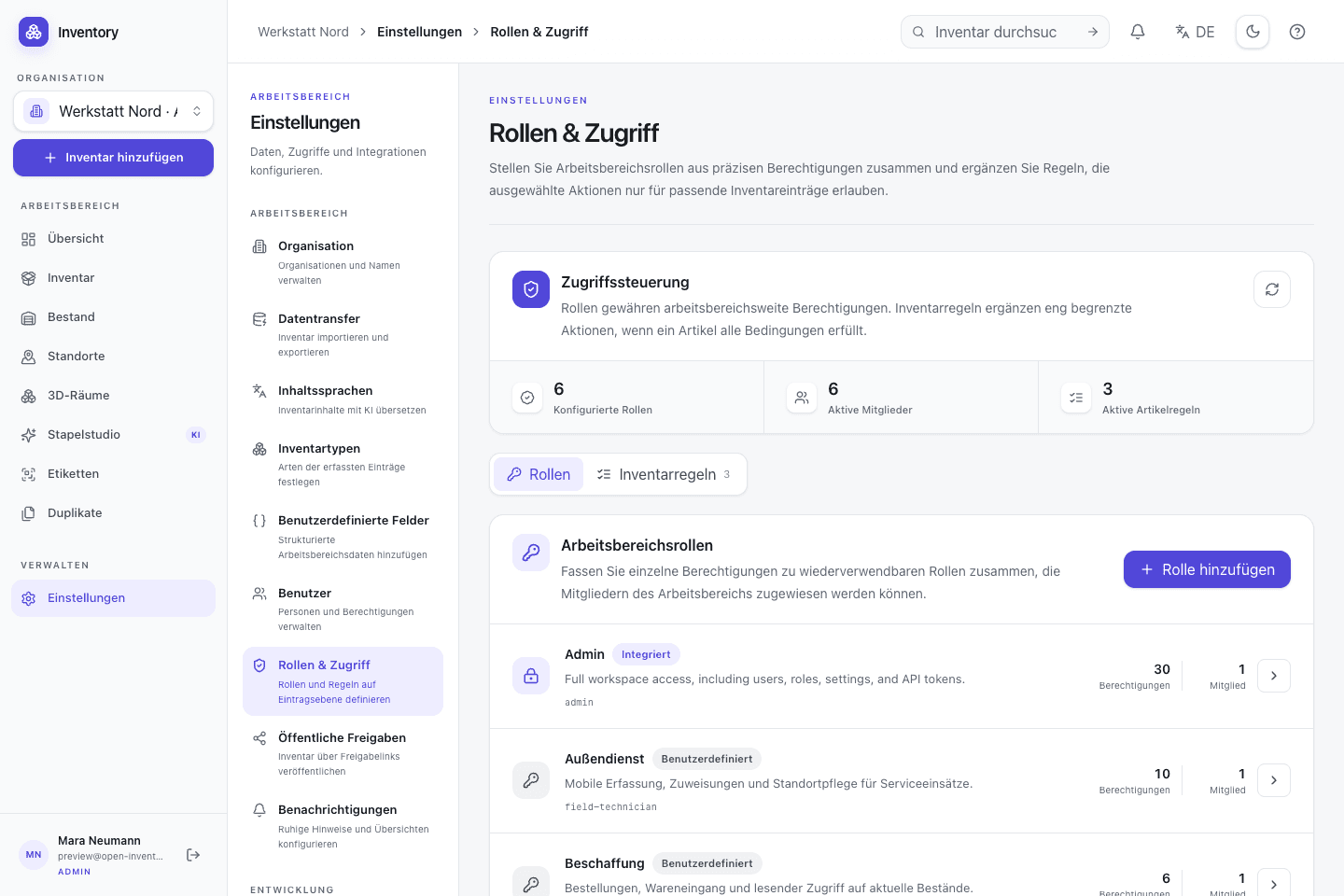
Manage local accounts, custom roles, granular permissions and content-dependent access rules. Auth0 or a standards-based OpenID Connect provider can be added for sign-in.
06 · Operate and secure
Roles, scoped tokens, persistent data and explicit provider boundaries turn inspectable code into a service that can be operated deliberately.
Scope
Self-hosting moves control and responsibility to the operator. Open Inventory provides Compose files, migrations, a health endpoint, PostgreSQL and persistent upload storage as a documented base. Backups, restore tests, TLS, network exposure and updates remain operational tasks.
Result 01
Run and inspect the web app, API and iOS client on infrastructure you control
Result 02
Define roles, granular permissions and content-dependent access rules
Result 03
Manage the database, files, secrets, backups and optional providers explicitly
Included implementation
These components are part of the MIT-licensed project. Optional providers are identified where they take part in a workflow.
Manage local accounts, custom roles, granular permissions and content-dependent access rules. Auth0 or a standards-based OpenID Connect provider can be added for sign-in.
Containers, migrations, a health endpoint and persistent volumes for PostgreSQL and local uploads are checked in. Configuration and secrets remain deployment concerns.
Store uploads in a persistent local volume by default or configure Openinary. Database and file storage must be backed up as one recoverable dataset.
Separate workspaces, data, and memberships within one deployment. Roles and permissions are evaluated in the currently selected organization.
Review estimated cost by action, provider, and status. An organization limit is checked before every paid AI call and can stop paid AI completely.
Keep selected views available offline on a trusted device. Disabling offline access or signing out removes the locally stored copies.
The web app, API and native iOS client are published in one repository. The MIT license permits inspection, modification, operation and redistribution.
Sequence
Starting Compose is the first step. Identity, persistence, recovery and controlled upgrades are required for a durable service.
Use the checked-in Docker Compose services, PostgreSQL, migrations and health endpoint as the baseline.
Configure accounts, roles and rules, then decide whether the instance is private or exposed through a hardened reverse proxy.
Back up PostgreSQL and the selected file store together, and verify restoration regularly.
Review repository changes, update images and migrations in a controlled sequence, and monitor the health endpoint.
Worked example
The values are mock data, but the workflow and state changes correspond to operations implemented by Open Inventory.
Example · Self-hosted instance
The web app and API run in a container, structured data lives in PostgreSQL and uploads live on persistent storage. External identity, AI or storage providers are present only when configured.
Application
Web · API · jobs
Persistent data
PostgreSQL · uploads
Optional
Identity · AI · storage
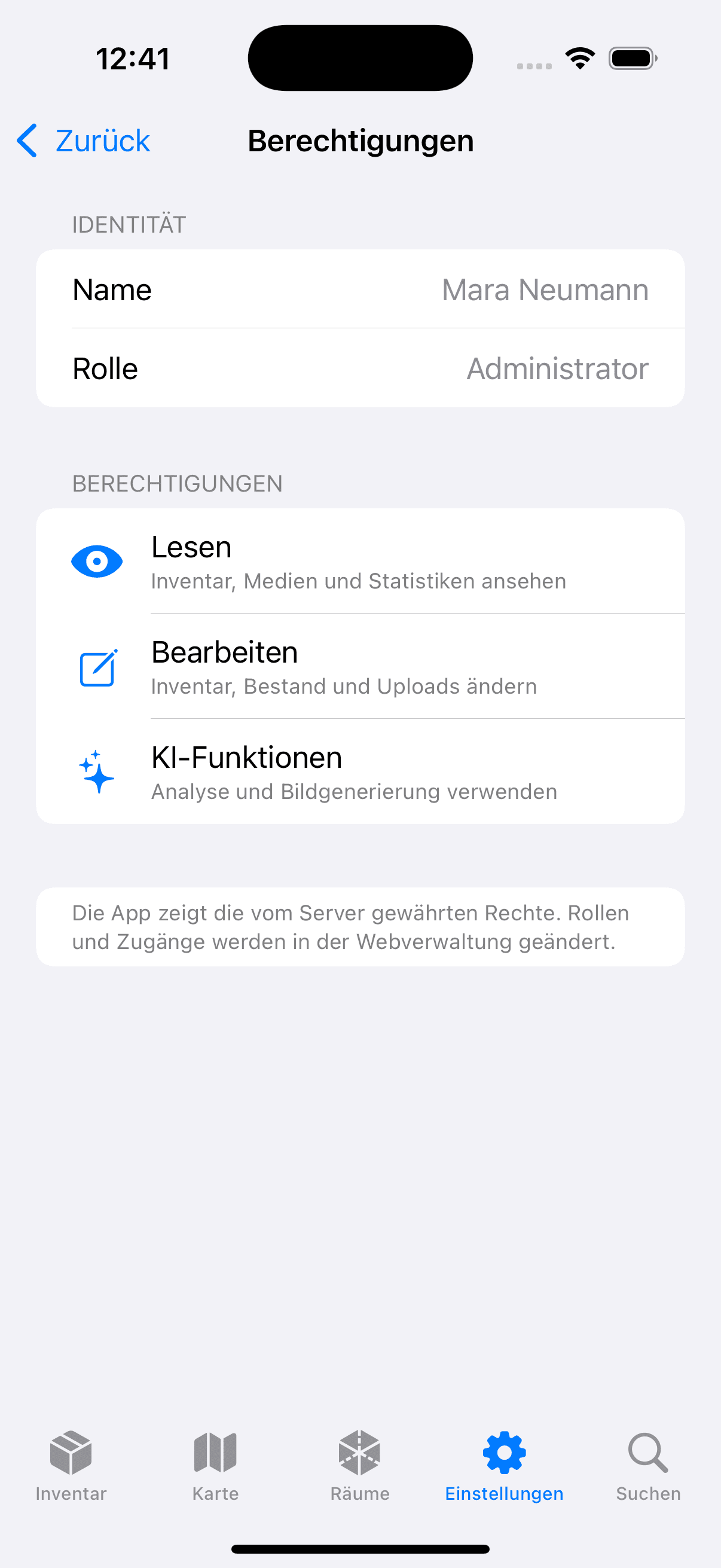
The native SwiftUI app is built from the same repository and uses a configured server origin. Reachability, TLS and certificate validity are therefore part of the deployment model.
Configure the server origin for the target instance
Inspect web, API and iOS code in one repository
Use HTTPS for connections outside a trusted local network
The MIT license permits inspection, modification, operation and redistribution. It does not replace upgrades, backups or secure network configuration. Those responsibilities remain with the operator.
MIT license and source for web, API and iOS
Docker Compose, migrations, health endpoint and persistent volumes
Public issues and pull requests with visible revision history
Next feature area
Capture starts at the object. Original media is retained, generated suggestions remain reviewable, and background work is split into visible stages.
Operate your own instance
Review the Compose services, persistence requirements and provider configuration before exposing an instance to a network.